AI-powered Solution
Azati’s AI-powered solution revolutionized the customer’s document processing workflow.
Azati, in collaboration with DIGATEX, developed a custom AI-powered document digitization system for complex engineering documents. The solution helps process, extract, and collate data from technical documents such as pipeline layouts, industrial plans, and maps.
documents/hour
accuracy rate
cost reduction


The goal was to create a fast, scalable, and cost-effective solution for digitizing large volumes of complex engineering documents. The system needed to automate the extraction of structured data from a wide variety of document formats, templates, and custom abbreviations.
Documents originated from multiple vendors, each using distinct formatting, templates, and symbol conventions. The system needed to automatically detect and classify the correct template for every document to ensure accurate data extraction, as misclassification could lead to errors or lost information.
Technical drawings, maps, and pipeline layouts often contain overlapping layers of information, including handwritten notes, stamps, and symbols. Accurately extracting structured data required interpreting visual hierarchies and resolving ambiguities caused by overlapping elements, which is especially challenging for automated systems.
Engineering documents include unique abbreviations, domain-specific symbols, and non-standardized notation. The challenge was to normalize this information into a structured format without losing meaning, requiring AI models capable of context-aware parsing and understanding of technical conventions.
Previous manual workflows were slow and prone to errors. The challenge was to create an AI system that could autonomously extract data at high accuracy while minimizing human supervision, enabling fast processing of large document volumes.
Azati evaluated existing OCR frameworks, including Tesseract, Keras OCR, and TensorFlow-based solutions, ultimately choosing a hybrid approach that combined classical OCR with deep learning to improve recognition of complex layouts, handwritten text, and technical symbols.
The team developed convolutional neural networks and transformer-based models trained to recognize document structure, diagrams, annotations, and multi-layered elements. A feedback loop was implemented to retrain the models continuously based on detected errors, improving accuracy over time.
A minimum viable product was deployed within two weeks to process an initial batch of documents. The MVP allowed the team to validate the system’s ability to handle various document types, measure extraction accuracy, and identify areas for improvement in a real-world scenario.
AI models were fine-tuned to handle engineering symbols, abbreviations, and template variations, while post-processing algorithms ensured consistency and correctness of extracted data. Continuous retraining brought the system’s accuracy up to 97%, making it reliable for large-scale operations.
The solution was integrated into a cloud-based architecture that allows scalable processing of high-volume document batches. Administrators can monitor performance, throughput, and accuracy through dashboards, and dynamic resource allocation ensures stable operation even under heavy loads.
Bring your complexity. We'll bring the plan. Select a convenient slot to start a conversation with our experts.
Schedule a callThis module automates the ingestion and digitization of engineering drawings, maps, and scanned technical documents. It uses custom OCR and Computer Vision algorithms trained to recognize both printed and handwritten text, symbols, and technical annotations even in complex multi-layered layouts. Each document is automatically indexed and converted into a searchable, structured digital format.
Once digitized, documents are processed by machine learning models that extract structured data and generate rich metadata. The module identifies document type, context, and key entities, automatically filling in metadata fields such as title, author, project, vendor, and revision. It also detects redundant or obsolete content, supporting efficient archiving and storage optimization.
This module validates the extracted data and detects anomalies in document structure, template recognition, or metadata consistency. AI models continuously learn from human feedback to improve extraction accuracy and flag potential data quality issues before final processing.
The final layer of the system ensures operational stability, transparency, and scalability. Administrators can monitor system performance, processing speed, data volumes, and overall accuracy through intuitive dashboards. As the entire infrastructure runs in the cloud, additional processing resources can be activated within minutes to handle large-scale digitization projects.
Azati’s AI-powered solution revolutionized the customer’s document processing workflow.
By automating the identification of templates and the extraction of data, the solution significantly increased throughput.
The system reduced document processing costs by five times, freeing up 30 employees from routine tasks.
The system processed 120,000 documents in less than 24 hours, achieving a fourfold decrease in data extraction time.
The project was completed in six weeks, far ahead of the customer’s original six-month timeline.

Oilfield reservoir analytics platform with 4 modules in 4 months, computational core rebuilt in 10 days, and ~1000X reduction in numerical precision loss after enterprise QA.
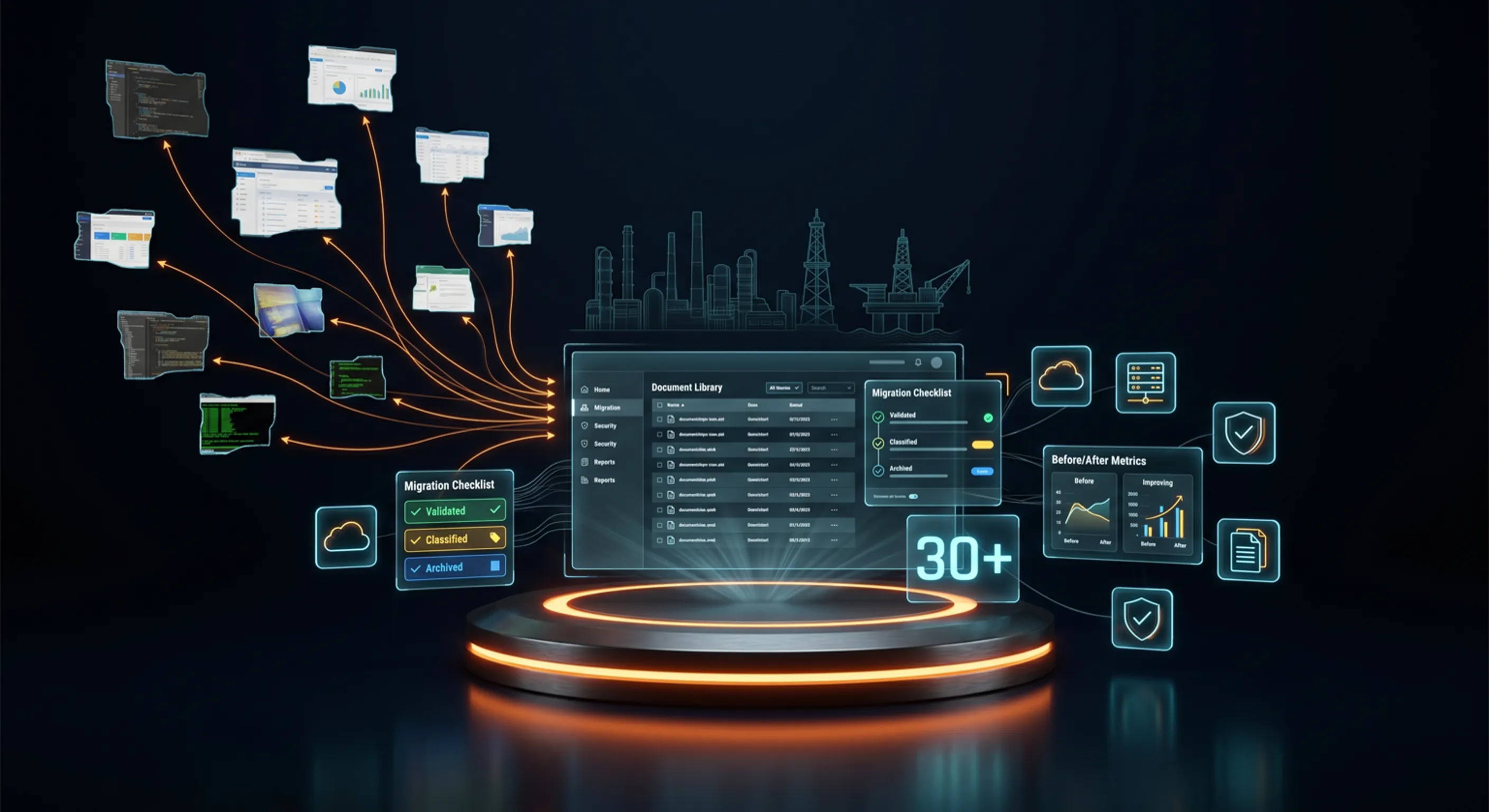
Sharepoint migration and portal consolidation for oil and gas, 30+ portals consolidated, 100,000+ content entities migrated, 15%+ customizations beyond initial estimation.
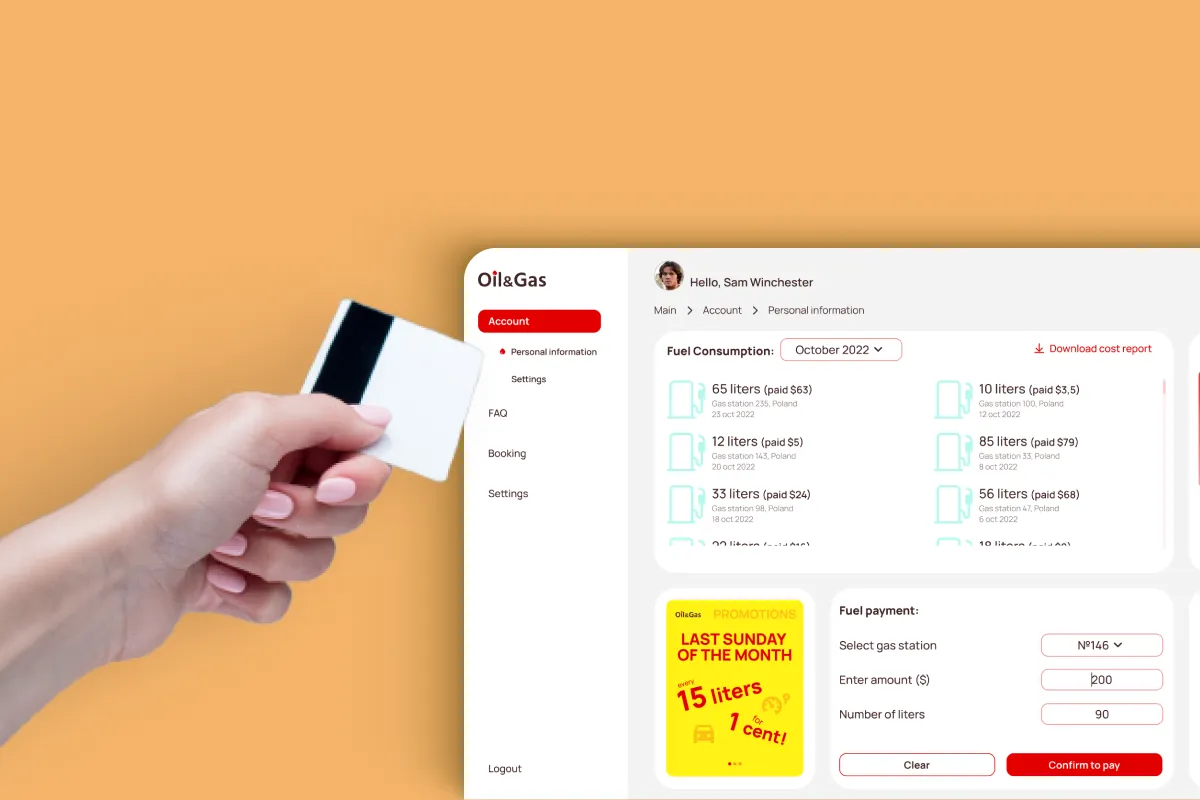
Optimized Oil&Gas web platform with streamlined workflow and fuel card management.

AI-powered service for automated oil & gas meter data reading and processing.

Data bus integrating SAP ERP with document generation for optimized workflows.
Last updated