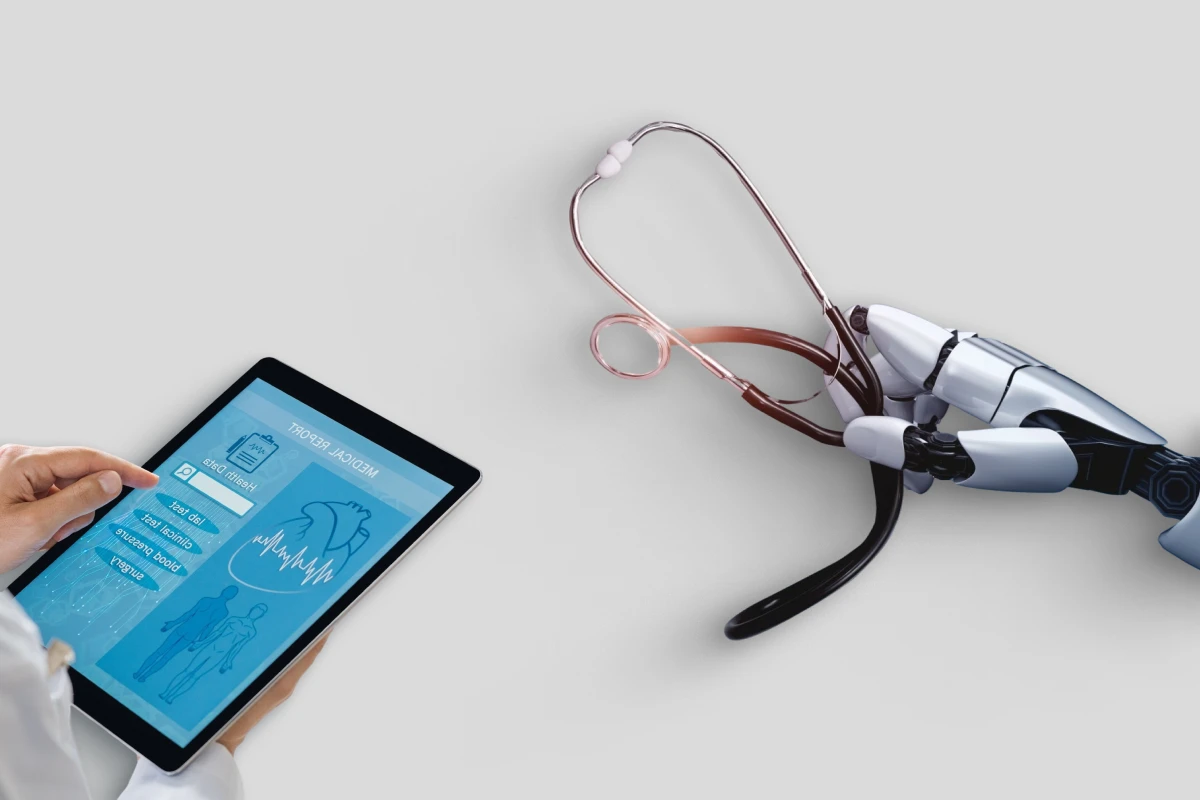
When diagnosing a patient to determine the presence and type of cancer, a doctor would analyse their test results. Needless to say that correctly diagnosing cancer as well as its type is a cornerstone of successful treatment.
The return of expert systems software
Today a doctor would turn to the literature on the subject and examine similar cases. But another option is entering the patient's test results and medical history into a computer program and comparing it to millions of similar pathology records. This represents the evolution of expert system technology into modern AI expert systems.
There are types and subtypes of cancer that are very rare and difficult to distinguish. And different subtypes of cancer may require dramatically different treatment plans.
Real-World Innovation: MIT's AI-Powered Expert System
To address this problem, a team from MIT's Computer Science and Artificial Intelligence Laboratory introduced a model that aims to automatically distinguish the type of lymphoma – a group of blood cancers. The model uses many techniques, among them are Natural Language Processing and Machine Learning, demonstrating the power of combining artificial intelligence and expert systems.
The model uses many techniques, among them are Natural Language Processing and Machine Learning.
The elaborated framework analyses pathology reports, which provide a comprehensive scope of measurements, observations, and interpretations made by pathologists – all expressed in natural language. With detailed feature analysis, their expert system generates meaningful features and medical insights into lymphoma classification.
The team's model can help doctors make more accurate diagnosis based on more comprehensive evidence. Imagine what great impact such an expert system would make if expanded across other institutions!
Now answers and advice of specialized domains can be provided not only by an intelligent expert, but via expert system software as well. And such software suits for professionals from any sphere – from insurance adjusters to engineers and managers. And do it even better than a human.
What are the expert systems
An expert system (ES) is a program that helps to solve problems within a specialized domain that ordinarily requires a human expert. By mimicking the thinking of human intelligent experts, the system can perform the analysis, design, or monitoring, make decisions and more.
In fact, such systems took their place long ago, and it is the first successful implication of Artificial Intelligence. But due to the poor development of AI, NLP, the Expert Systems did not live up to the business-world expectations and the term itself has left out from the IT-world lexicon.
But now, with the rapid development and prominent advancements of Artificial Intelligence, Machine Learning, Deep Learning and Natural Language Processing we are about to observe the comeback of expert systems. They have different names, but the essence stays the same – solving expert-level issues.
Understanding the Difference Between AI and Expert System
The difference between AI and expert system is fundamental to understanding both technologies:
| Aspect | Expert Systems | Artificial Intelligence |
|---|---|---|
| Scope | Narrow, domain-specific | Broad, general-purpose |
| Knowledge | Encoded by human experts | Learned from data |
| Reasoning | Rule-based, transparent | Often probabilistic, may be black-box |
| Flexibility | Limited to programmed rules | Adapts to new situations |
| Explainability | High | Variable |
Major Components of Expert Systems
Understanding expert system architecture is crucial for grasping the difference between AI and expert system approaches.
1. Knowledge Base: The Core of Every Expert System
The power of expert systems stems from the specific knowledge about a narrow domain one stores. The knowledge base of an ES contains both factual and heuristic knowledge – the expertise of intelligent experts codified into structured information.
Real-World Example: IBM Watson's expert system knowledge base contains information from over 200 million pages of text, including medical journals, textbooks, and clinical trial data – demonstrating how artificial intelligence and expert systems can scale knowledge representation.
2. Inference Engine: The Reasoning Mechanism
The inference engine provides a methodology for reasoning about information in the knowledge base. Its goal is to come up with a recommendation, and to do so it combines the facts of a specific case (input data) with the knowledge contained in the knowledge base.
Inference can be performed using semantic networks, production rules, and logic statements. There are two types of data-driven strategies – forward and backward chaining.
- Forward chaining is applied to make predictions (data-driven reasoning);
- Backward chaining finds out the reasons why a certain act has happened (goal-driven reasoning).
3. User Interface: Bridging Experts and Users
The hardware and software that provides interaction between program and users, allowing non-experts to access the knowledge of intelligent experts through the expert system.
Types of Problems That Expert Systems Can Solve
Expert systems can be differentiated by the action they perform or a type of problem they help resolve. Understanding these categories clarifies when to use expert systems vs AI approaches.
Classification & Diagnosis: Diagnostic Expert Systems
Identify an object based on stated characteristics – the most common application of diagnostic expert systems.
Examples:
- Medical disease diagnosis (AI expert systems in healthcare);
- Insurance application fraud detection;
- Equipment fault diagnosis;
- Quality control in manufacturing.
Monitoring: Real-Time Expert System Applications
Continuously comparing data with prescribed behavior – showing the synergy of AI and expert systems.
Examples:
- Leakage monitoring in long petroleum pipeline;
- Finding out faults in vehicles;
- Network security monitoring;
- Industrial process control.
Prediction: Forecasting with Expert Systems
Showing the optimal plan, where expert system vs AI distinctions blur in modern implementations.
Examples:
- Prediction of share market status;
- Contract estimation;
- Weather forecasting systems;
- Demand prediction in retail.
Design: Configuration Expert Systems
Configuring a system according to specifications, classic expert system application.
Examples:
- Airline scheduling;
- Cargo scheduling;
- Computer system configuration;
- Manufacturing process design.
Benefits of Expert Systems in 2025
Expert Knowledge Becomes Available to Everyone
Expertise is very difficult to obtain and capture. At a certain point, many intelligent experts deepen their understanding to such a degree, that their decisions become somewhat intuitive. As a result, their explanations wouldn't be of much help. Besides, their time is precious and should not be dispersed on indirect tasks too often.
But once expert knowledge was mined and stored into expert system software in a structured way, it can then be easily retrieved and comprehended.
Pieces of Information Are Taken Together
The specialists whom a professional might like to consult may be not within reach. Also, a specialist may be not aware of modern inventions, new studies and discoveries related to a part of their job.
An Expert System Software can be of great help by offering knowledge of similar cases, especially if used by an international company. Besides, an Expert System can also serve as a self-check tool.
Automation & Speed: Expert Systems Work 24/7
ESs offer great speed and reduce the amount of work an individual puts in.
Reduced Errors and Risk
An ES's error rate is lower as compared to human errors. Not to mention the fact that they can work in the environment dangerous to humans.
Help Even to Non-Experts
An ES can help by serving as a training tool for young employees and non-experts, democratizing access to intelligent expert knowledge.
Expert Systems vs Artificial Intelligence: Understanding the Relationship in 2025
The Fundamentals: What is the Difference Between AI and Expert System?
A short reminder: Artificial Intelligence is the field of Computer Science that is devoted to giving the machines features that are associated with human intelligence. These include reasoning, evaluation, learning, language recognition, decision-making and problem solving.
Expert systems were the first successful implication of Artificial Intelligence to the purposes of business. Their decision-making was rule-based – it consisted of the great number of "if – then" rules. For instance, "If it is sunny, then I'll go swimming", and so on.
Rule-based expert systems are the simplest form of Artificial Intelligence. But such an approach wasn't enough for a really powerful, robust Expert System Software.
The Historical Challenges of Expert Systems
Rule-based decisions couldn't deal with many issues. For example, the expert systems often failed when faced with a new, not hard-coded situation. It was also challenging to gather expert knowledge ("data acquisition" problem) and construct a knowledge base.
As a result, Expert Systems did not live up to the business-world expectations. For a while, they have sunk into oblivion.
The Evolution: From Rules to Data-Driven AI
A shift from rule-based approach to a data-driven one paved the way to a new era in Artificial Intelligence.
Prior to advancements in AI, there was a serious increase in computing power capabilities. Also, data became easier to gather and inexpensive to store. Then, the whole AI paradigm has changed.
Instead of making a system that is attempting to draw logical conclusions based on predefined rules, AI software began to use a data-driven and probability-based approach. By exposing large quantities of known facts to a learning mechanism, and performing tuning sessions, you get a system that can make predictions or identifications of unseen cases.
This is an approach of constant trial and error. That is, in essence, the underlying concepts of Machine Learning.
Comprehensive Comparison: Expert System vs AI
| Aspect | Traditional Expert Systems | Modern AI | Hybrid AI Expert Systems (2026) |
|---|---|---|---|
| Knowledge Source | Human intelligent experts | Data-driven learning | Both expert rules + learned patterns |
| Decision Method | Rule-based ("if-then") | Probabilistic, neural networks | Combined reasoning |
| Transparency | High | Often "black box" | Explainable AI with rule traces |
| Learning | Static, requires manual updates | Continuous learning | Semi-automated knowledge updates |
| Domain | Narrow, specialized | Can be broad | Specialized with transfer learning |
| Data Requirements | Low (expert knowledge) | High (millions of examples) | Moderate (bootstrapped with rules) |
| Maintenance | Requires artificial intelligence experts | Automated retraining | Hybrid approach |
| Best Use Cases | Well-defined, rule-heavy domains | Pattern recognition, complex data | Critical decisions requiring explanation |
For Expert Systems, It Seems, The Tide Has Turned
If we define an Expert System by its direct use – as a software intended to solve expert-level problems and tasks, rather than by the method of achieving it, we are quite sure they are about to return.
Diagnostic Expert System Applications: The Comeback Story
Diagnostic expert system applications continue to be the most popular. One example could be IBM's Watson is better at diagnosing cancer than human doctors.
Breakthrough Example: Memorial Sloan Kettering's diagnostic expert system collaborates with IBM Watson to analyze patient records against 300+ medical journals, 200+ textbooks, and 15 million pages of clinical data, showcasing how artificial intelligence and expert systems enhance cancer care.
Recommendation Systems: Modern Expert Systems
Also, in more recent years recommendation systems have taken over in recommending products to customers. A notable development was the Netflix Prize competition for movie recommendations which led to a burst of innovation and interest in the area.
2026 Applications Across Industries
New expert system applications emerging:
Legal Expert Systems:
- ROSS Intelligence uses AI expert systems for legal research, analyzing millions of cases;
- Contract review systems processing 10,000+ pages per hour.
Financial Services:
- Fraud detection expert systems at Mastercard evaluate 75 billion transactions annually;
- Credit scoring systems combining rules with machine learning.
Manufacturing:
- Predictive maintenance expert systems reducing downtime by 52% (Siemens case study);
- Quality control systems inspecting 100% of production output with 99.7% accuracy;
- AI-powered supply chain optimization systems.
Energy Sector:
- Grid management expert systems optimizing power distribution;
- Oil & gas exploration systems analyzing geological data.
Building Modern Expert Systems in 2026
It requires a large amount of data and as always a team of professionals with substantial expertise in software development and Machine Learning.
Requirements for Building an AI Expert System:
1. Domain Expertise
- Access to intelligent experts in the field;
- Documented knowledge and best practices;
- Real-world case studies and scenarios.
2. Technical Infrastructure
- Knowledge representation frameworks;
- Inference engine platforms;
- Integration with AI and machine learning tools.
3. Development Team
- Knowledge engineers to codify expert knowledge;
- Artificial intelligence experts and data scientists;
- Software developers and system architects.
4. Data Resources
- Historical case data for validation;
- Continuous feedback loops for improvement;
- Integration with external knowledge sources.
Best Practices for Expert System Development:
- Start with clear scope: define the expert system's domain boundaries;
- Engage intelligent experts early: continuous expert involvement throughout development;
- Hybrid approach: combine rules with AI and machine learning where appropriate;
- Explainability first: ensure the system can explain its reasoning;
- Continuous validation: test against real-world cases regularly.
The Future: Artificial Intelligence and Expert Systems Working Together
The difference between AI and expert system is becoming less relevant as both technologies converge. The future lies in intelligent expert systems that combine:
Strengths of Expert Systems:
- Transparent, explainable reasoning;
- Incorporation of human expertise;
- Reliable performance in well-defined domains;
- Regulatory compliance and auditability.
Strengths of AI:
- Learning from data;
- Handling ambiguity and uncertainty;
- Scaling to handle big data;
- Discovering patterns humans might miss.
Want to unlock the full potential of AI or build your own expert system?
Whether you're looking to develop diagnostic expert systems for healthcare, implement AI and expert systems for financial services, create knowledge-based expert systems for manufacturing, or leverage intelligent expert knowledge in any domain, the right expertise makes all the difference.
Our Expert System Development Services:
- Expert system architecture design and implementation;
- Knowledge base development and maintenance;
- AI expert system integration with existing workflows;
- Artificial intelligence expert consulting and training;
- Hybrid AI and expert systems solutions.
Let's talk about how we can make that happen together and build an expert system that captures and amplifies your organization's expertise.
Contact our artificial intelligence experts today to start your expert system journey!